Materials
Six finishes, and what each one is really for.
Every finish in the program is cabinet-grade melamine on a stable core, with matched heat-applied edge banding. What separates them is sheen, figure and how they behave in the light your room actually has.

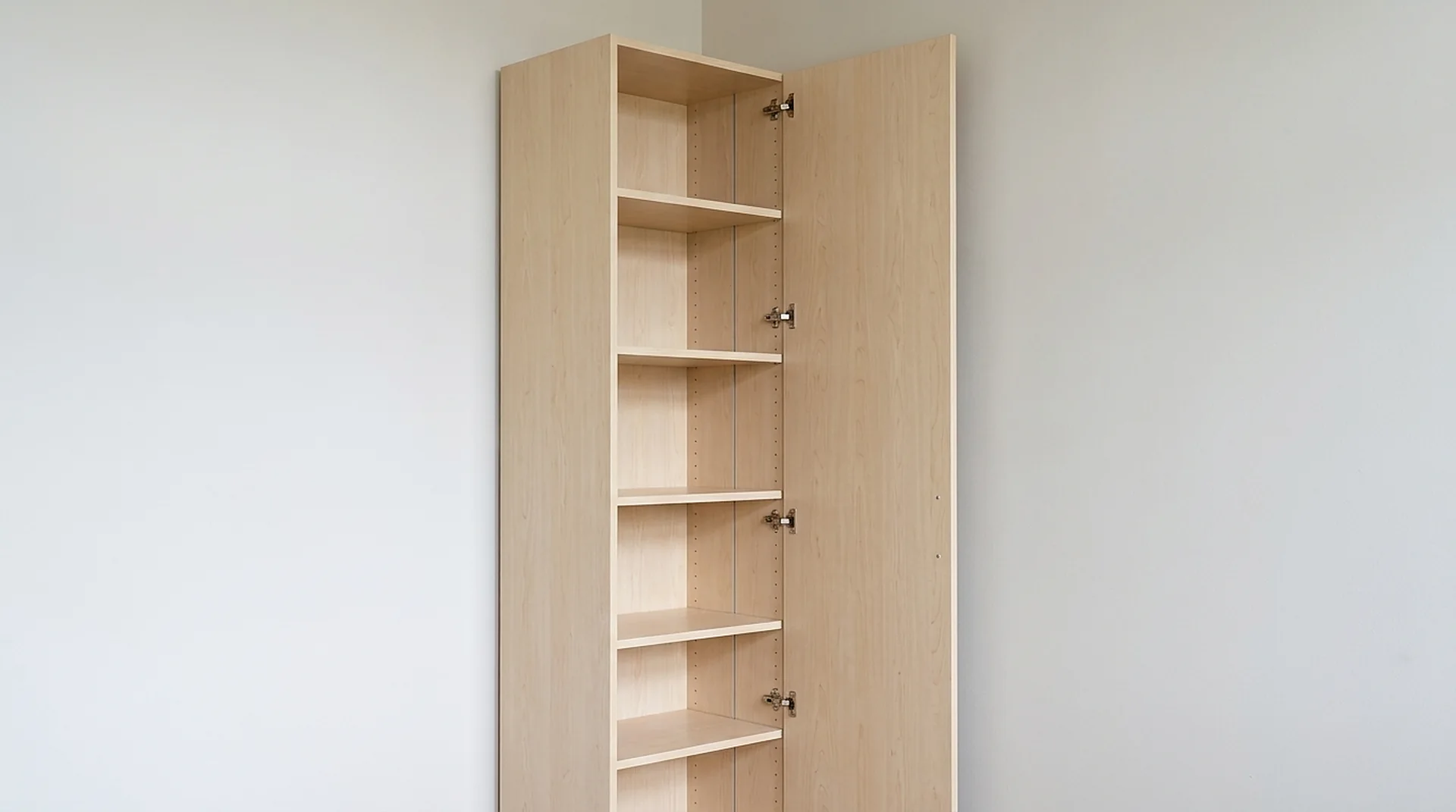
A soft, low-contrast oak grain that reads warm in daylight and neutral under LED.
Downy Wood Grain is the finish that lets a closet sit in the same visual family as a kitchen. The same decor paper is available on cabinet panel, so a closet run and a kitchen island can be specified as a matched pair rather than two near-misses.
Pairs with Brushed brass · Matte black
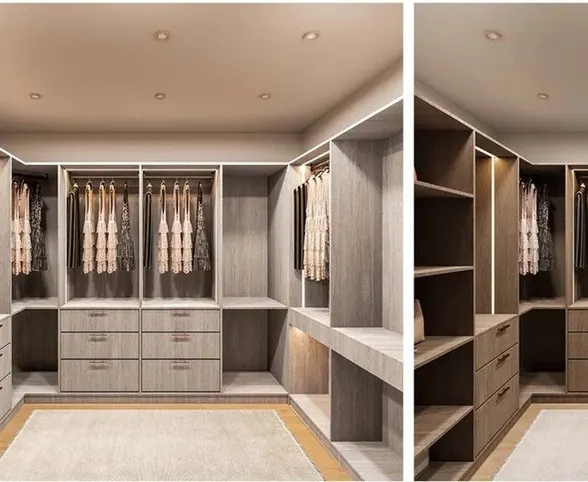
The warmest option in the program — a mid-tone oak with visible cathedral figure.
Natural Oak carries the most figure of the three wood grains. It is the usual choice for open, doorless walk-in layouts where the cabinet body itself is the finished surface and every shelf edge is on show.
Pairs with Brushed brass · Brushed nickel
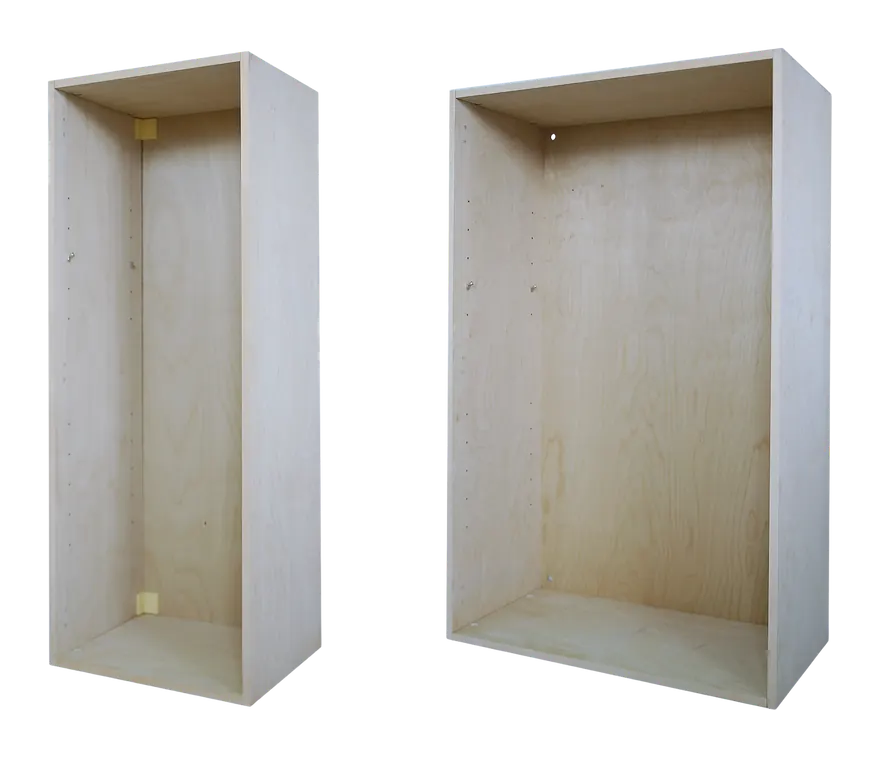
A pale, straight-grained birch look for rooms that need to feel larger than they are.
Logwood Grain reflects more light than the other two grains, which makes it the default for home offices, small reach-in closets and any run placed against a dark wall or concrete.
Pairs with Matte black · Brushed nickel
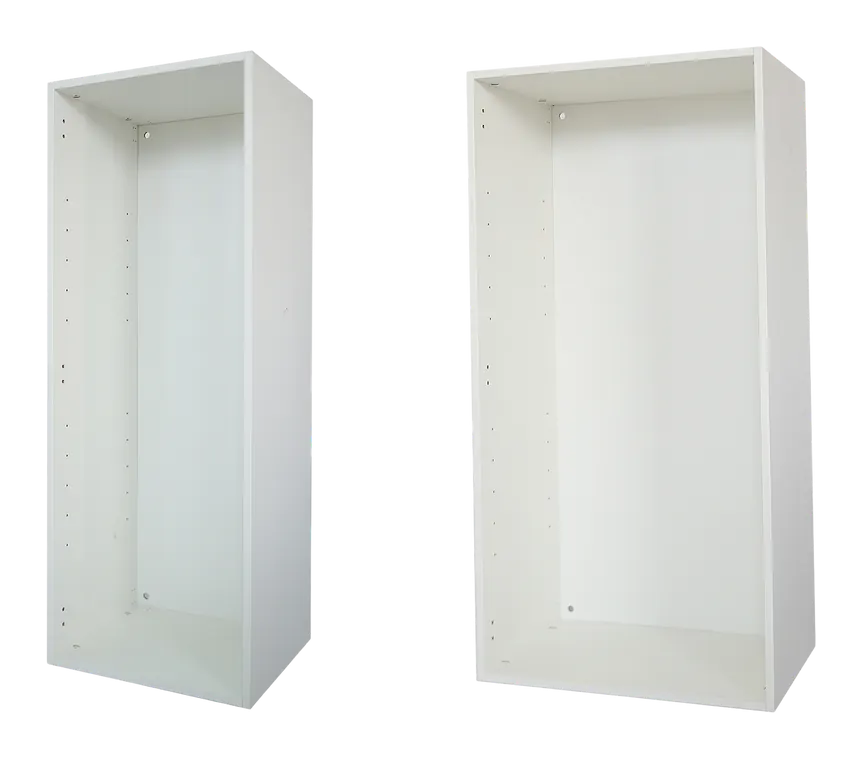
A low-sheen white that hides fingerprints far better than a gloss panel.
Matte White is the highest-volume finish in the program and the one specified for almost every laundry room. Low sheen means glancing light does not telegraph every seam and handprint the way a high-gloss door does.
Pairs with Matte black · Brushed nickel
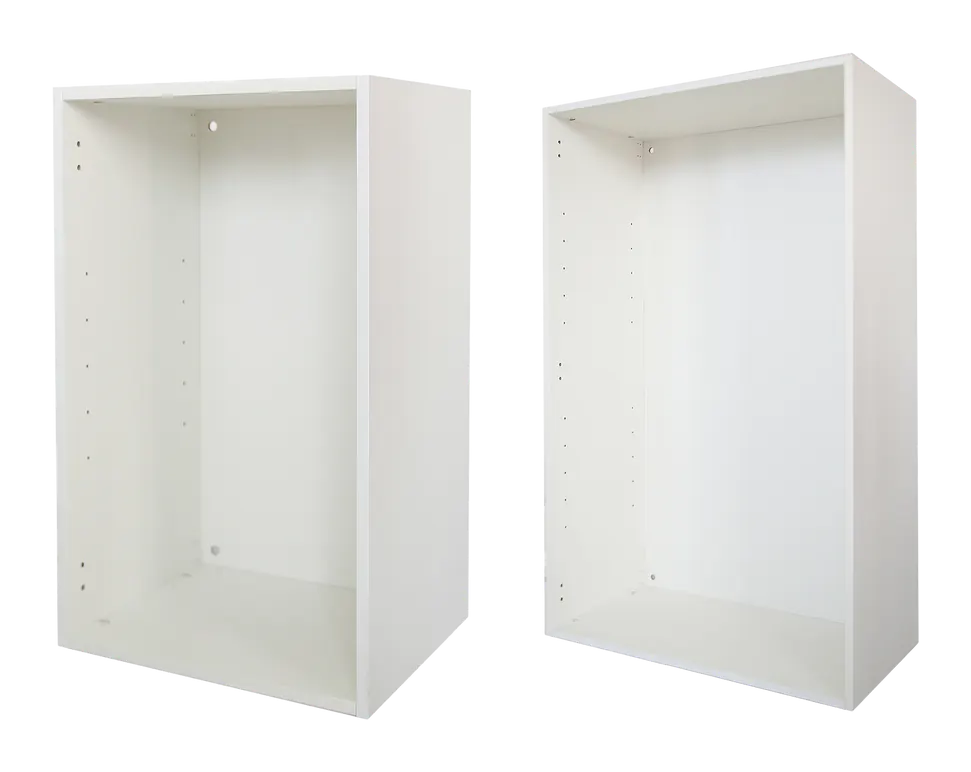
A fine woven texture in mid grey — quiet, contemporary, forgiving on long runs.
Grey Linen has a shallow embossed texture that breaks up reflections. On a run longer than twelve feet, that texture is what keeps a wall of cabinet from reading as a flat gray slab.
Pairs with Brushed brass · Matte black
A mirror-finish door face used as an accent, not a whole room.
High Gloss Black is specified for door faces and island panels — rarely for a full room. Used against a wood grain interior it turns a closet into a display case; used everywhere it turns a closet into a fingerprint map.
Pairs with Brushed brass
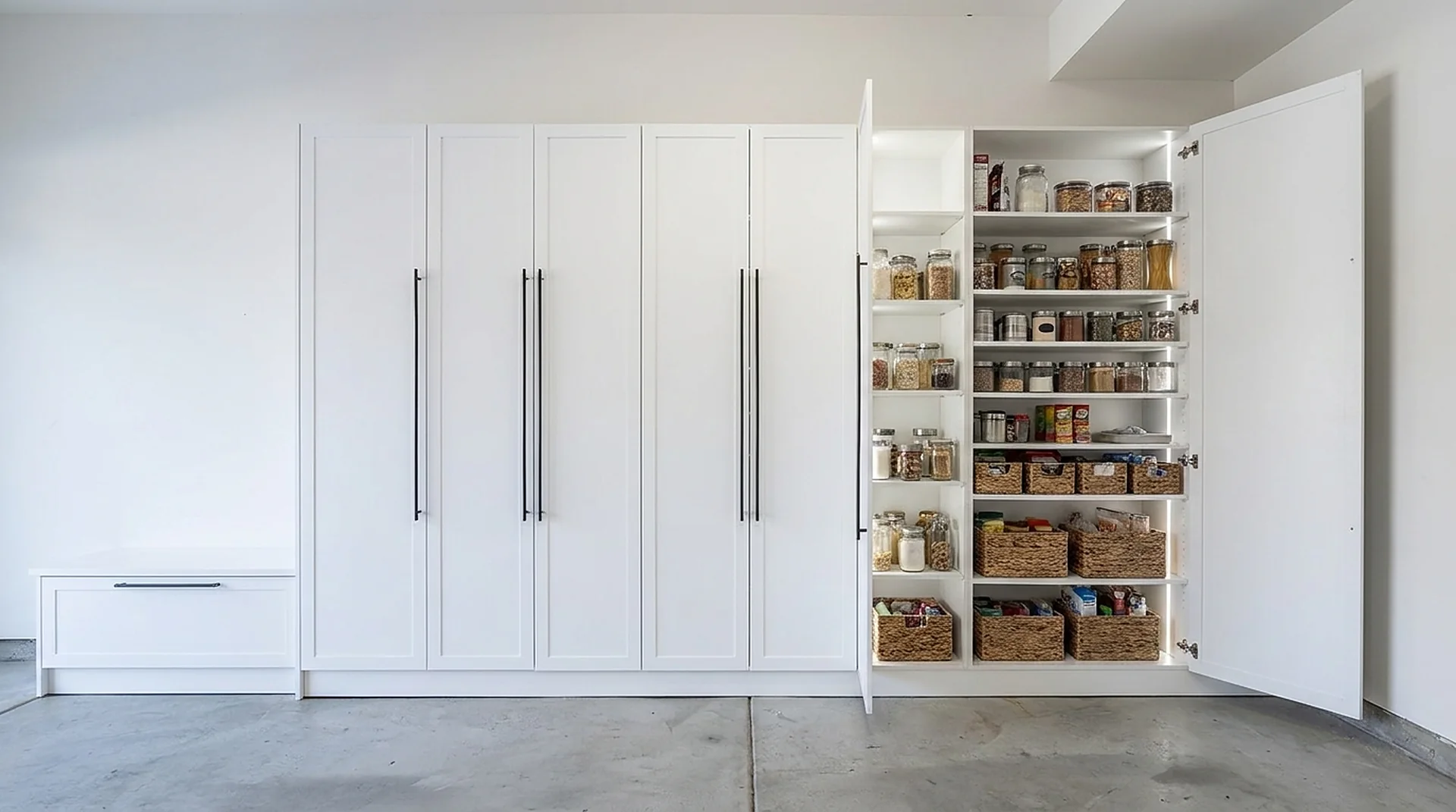
Panel matching
A closet that agrees with the kitchen.
Downy Wood Grain is available on both closet panel and kitchen cabinet panel. That means a butler's pantry, a mudroom and a kitchen island can be specified from one decor rather than three finishes that nearly agree — which, in daylight, is the difference nobody can name but everybody sees.
Samples go home with you, and they can also be seen at the workshop on Pacific Drive in Norcross. It is a workshop rather than a retail showroom, so visits are by appointment: call ahead and the finish samples and a sample tower will be out for you.
Further reading: Melamine Closet Care, Walk-In Closet Trends 2026, Do Custom Closets Add Home Value? An Honest Answer.
- One decor, two programsThe same paper on closet and kitchen panel.
- Take the sample homeMatching is judged in your light, at your time of day.
- Specify onceOrdering both at the same time avoids a batch difference.
Material
What melamine actually is.
| Core | Engineered wood substrate, 3/4 in |
|---|---|
| Surface | Thermally fused decor paper, sealed |
| Edge | Matched banding, heat-applied to visible faces |
| Moisture | Sealed surface; not rated for standing water |
| Scratch | High surface hardness; harder than a painted door |
| Stability | Does not move seasonally the way solid wood does |
| Cleaning | Damp cloth, mild detergent, no abrasive pads |
Reading a quote
Melamine, thermofoil, powder coat: what the words mean.
Closet quotes in Atlanta tend to use three material words, and they name constructions, not grades. Melamine (thermally fused laminate, TFL) is a resin-saturated decor layer fused to an engineered-wood core under heat and pressure — and the construction every ClosetX cabinet, door and partition panel is made of. Thermofoil is a vinyl film vacuum-pressed over an MDF core, most often seen on shaped door fronts. Powder coat is a baked finish that belongs to metal components rather than panels. None of the three words says anything about quality on its own; each behaves differently against moisture, scratching and cleaning, which is why the material of the cabinet box and the material of the door front are worth checking separately on any quote you compare.
Some quotes name two more materials. Wood veneer is a thin layer of real wood over plywood or an engineered core; melamine costs a fraction of veneered plywood for the same span. Solid wood is a wonderful material for a visible face frame or a piece of furniture, but not for wide panels such as shelves: it cups through a humid Georgia summer and costs the most by a wide margin.
Door profile is the second word worth checking. The ClosetX program supplies doors and drawer fronts as a flat slab — one continuous surface, the easier front to wipe — or a shaker profile where the room has traditional trim to answer to, both in any program finish on concealed soft-close hinges. The full run of door and panel options lives on doors and partition panels.
The profile people usually ask about next is the raised panel — a door with a shaped, stepped center panel — and ClosetX does not build one. That is a material decision rather than a stylistic one. A raised center has to be shaped, which means an MDF core wrapped in vinyl film or a solid timber door; neither is the thermally fused panel this program is built from, and running one profile in a different material would break the thing that makes the run match — every door, drawer front and partition coming out of the same finish batch. If a raised panel is what the room needs, a cabinet maker working in timber is the honest recommendation. If the question is really traditional-versus-plain, the shaker profile answers it: a recessed flat center inside a square frame, which reads as trim work next to paneled walls without introducing a second material into the closet.
Deciding
What you are actually comparing.
Choosing a finish is three decisions, not one: the decor itself, the door face it lands on, and the material the panel is made of. Each has its own page. How to choose a closet finish walks the decor decision under real light; doors and partition panels covers the door faces the same decor is available on; and melamine vs wood vs wire is the material comparison behind those finishes. Terms used here are defined on the glossary.
Questions
About the material.
What are ClosetX closets made of?
Three-quarter-inch cabinet-grade melamine panel with heat-applied matched edge banding, drilled on a 32 mm system hole pattern. Drawers run on full-extension soft-close slides and doors hang on concealed soft-close hinges.
What are the disadvantages of melamine board?
The limits follow from the construction: a decor layer fused to an engineered-wood core. A cut edge is raw core until it is banded, so an unbanded edge chips and takes on moisture; a deep scratch cannot be sanded out and refinished the way solid wood can; and the panel is heavy for its span. Banding every exposed edge and carrying shelf load on system pins rather than on the panel face answers most of it.
Is melamine better than wood for a closet?
For closet interiors, yes, in the ways that matter. Melamine is dimensionally stable across seasons, so shelves stay flat under folded weight; the surface is sealed against moisture and abrasion; and it costs a fraction of veneered plywood for the same span. Solid wood is the better choice for a visible face frame or a piece of furniture, not for a 36-inch shelf that has to carry sweaters for twenty years.
What is the smallest a walk-in closet can be?
Five feet wide by four feet deep, and only with cabinets on one wall. A 24-inch-deep run plus the 36-inch walkway you need to stand and turn in uses 60 inches exactly, so 5 feet is the minimum and about 5 feet 6 inches is comfortable. Putting cabinets on two facing walls needs seven feet — 24 plus 24 plus a 36-inch aisle. Below those numbers the doors and drawers collide and the room works better as a reach-in.
What are the pros and cons of melamine, wood and wire closet systems?
Wire is the cheapest and the most often replaced: it carries load on widely spaced steel rods, so knitwear and folded shirts take a ridge pattern, it cannot be closed with a door that reads as cabinetry, and it offers no drawer path. Solid wood looks the part, but wide panels cup and move seasonally through a humid Georgia summer and it is the most expensive by a wide margin. Cabinet-grade melamine is the default because a 3/4-inch panel stays flat under folded clothes and takes an edge-banded front face. Its honest con is that it is not repairable the way wood is — a damaged panel is replaced rather than sanded, which in this program is cheap because every part is a cataloged SKU.
Is melamine safe for closets?
The surface is not where the question lives. Melamine here means TFL — a thermally fused laminate bonded to a particleboard core — and the laminate itself is inert, wipe-clean and does not off-gas. What people are actually asking about is formaldehyde from the core, and that is a real question with a specific answer: in the United States, composite wood panels sold for interior use must meet the TSCA Title VI emission limits, the federal rule that adopted California's CARB Phase 2 standard. That is the document to ask any closet supplier for, by name, rather than accepting the word 'low-VOC' on a brochure. ClosetX cabinets are built from 3/4-inch cabinet-grade melamine panel with the visible front edges banded, which also matters here: banding seals the cut core against humidity, and a closet in a Georgia summer is a humid box. If a closet smells strongly for more than a few days after installation, ventilate it and raise it with your supplier — that is not something to live with.
What materials do you use?
Five things, and it is worth knowing them by name before comparing quotes. The cabinet panel is 3/4-inch cabinet-grade melamine — TFL, a thermally fused laminate over a particleboard core — with the visible front edges banded. The decor comes from a program of six finishes, three wood grains and three solids, and every part in a run is specified in the same one. Doors and drawer fronts are supplied in two profiles, flat slab or shaker, on concealed soft-close hinges. Drawer boxes are melamine panel in the same decor as the run rather than a dovetailed timber box, on full-extension soft-close runners — in a closet the runner is what fails, not the box, so that is where the program spends. And every shelf and rod sits on a 32 mm pin grid, which is why a shelf moves later without tools. What we do not use is solid wood for wide panels: it cups through a humid Georgia summer and costs the most by a wide margin.
Start here
Tell us the room. We will tell you what fits.
A field measure, a dimensioned drawing and a fixed price — in that order, before anything is cut.