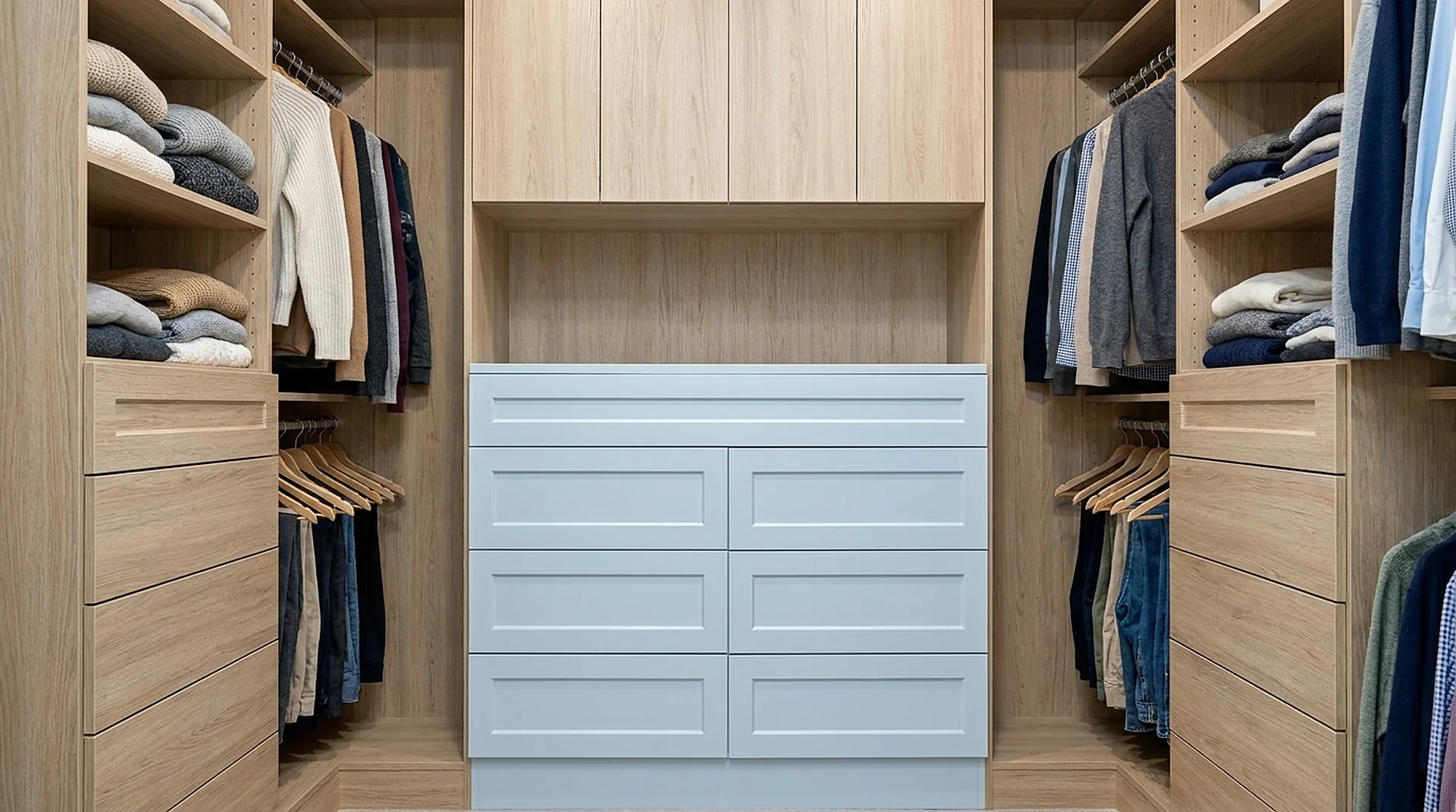
Planning
Shelf or Drawer? How to Decide, Item by Item
Drawers cost several times what shelving costs per foot. Here is which garments actually earn one, and which are better off folded in the open.
Put small, loose items that need containment in drawers — socks, underwear, accessories — and put anything that stacks and stays stacked on an open shelf, because a drawer costs several times what the same width of shelving costs.
This is the decision that moves a closet quote more than finish, door style or lighting combined. It is also the one most often made by default: people ask for "lots of drawers" because a dresser had them, without asking what each drawer is actually going to hold.
What a drawer is genuinely better at
- Small loose items. Socks, underwear, belts, watches. These do not stack; on an open shelf they become a pile within a week.
- Anything you want out of sight. A drawer is the only closed storage that stays organized, because a shelf behind a door is still a shelf.
- Items that need protection from dust. Jewelry, occasion accessories, anything used a few times a year.
What belongs on a shelf
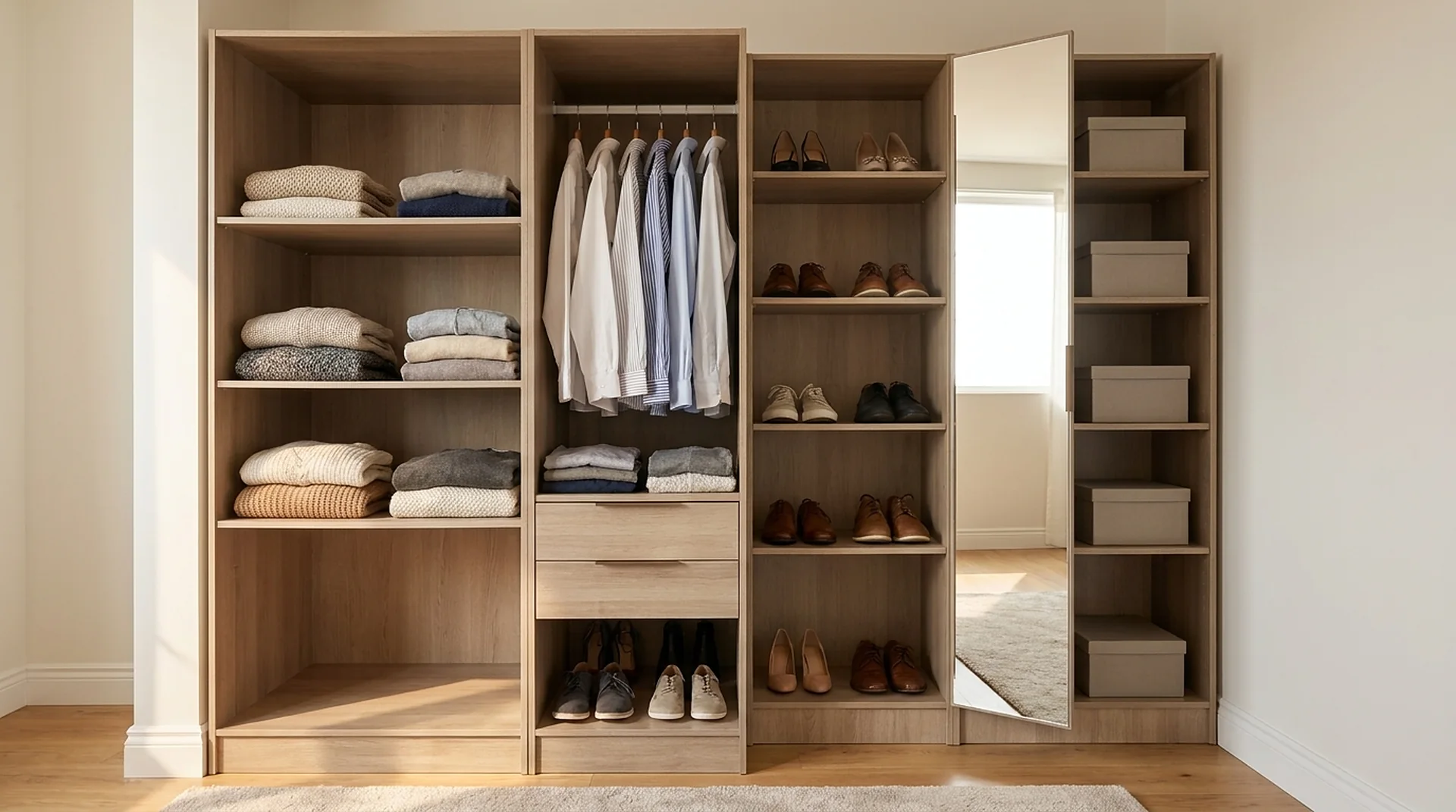
Anything that holds its own shape in a stack. Folded knitwear, jeans, T-shirts, handbags stood upright, shoes on an angled shelf. A stack of six sweaters on an open shelf is easier to use than the same six in a drawer, because you can see the whole stack and take from the middle without disturbing it.
The cost arithmetic
| Same 30-inch width | Relative cost | Holds |
|---|---|---|
| Open adjustable shelving | 1× | Folded stacks, bags, boxes |
| Shelving behind a door | 1.6× | The same, hidden |
| Drawer stack | 3–4× | Small loose items, contained |
The multiplier is real material, not margin: a drawer is a box inside a box, on runners, with a front. That is five panels and a mechanism where a shelf is one panel.
Drawer depth is a trap
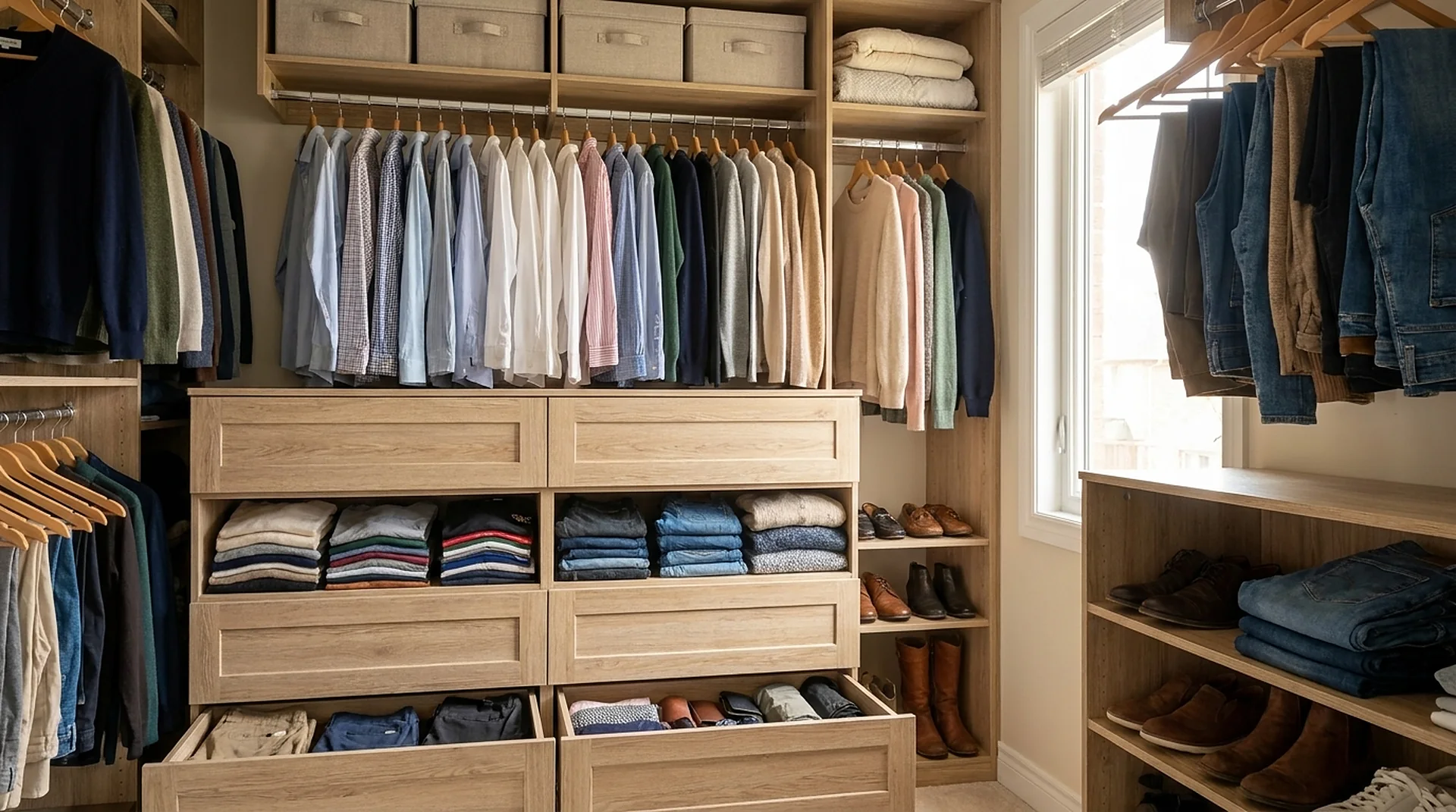
Deep drawers feel generous and behave like bins. Anything below the top layer stops being retrievable, so a 12-3/5-inch drawer of folded T-shirts is a 6-inch drawer with archaeology underneath. We build two heights for that reason — 6-2/7 inches and 12-3/5 — and the arithmetic is close to a wash: four shallow drawers stack to 25-1/7 inches, two deep ones to 25-1/5. The same tower height either way, and the four hold considerably more of what you actually reach for.
A working ratio
For most wardrobes, one 30-inch drawer stack of four to five shallow drawers covers everything that genuinely needs containment. Beyond that, additional drawers usually replace shelving that was doing the job better and cheaper. If the budget is fixed, the trade to consider is one fewer drawer bank against going to the ceiling across the whole run.
The ratio gets set at the field measure, not from a chart. If you are near our Norcross shop, closet organizers in Peachtree Corners shows what that decision looks like as an installed run.
Quick answers
About this topic.
How many drawers does a closet need?
Most wardrobes are well served by one 30-inch stack of four or five shallow drawers — 30 inches is the widest drawer we build, in the 6-2/7-inch shallow height. Beyond that, drawers usually displace shelving that was doing the same job for a quarter of the cost.
Are deep drawers better than shallow ones?
No. Below the top layer a deep drawer stops being retrievable, so four shallow drawers deliver more usable storage than two deep ones.
Should drawers go inside the closet or stay in a bedroom dresser?
Inside, if the floor under a hanging bay is otherwise empty — that is the most wasted area in a builder-grade closet, and filling it often lets the dresser leave the bedroom entirely.
Start here
Tell us the room. We will tell you what fits.
A field measure, a dimensioned drawing and a fixed price — in that order, before anything is cut.