Planning
Hanging Math: How Much Rod Length Do You Actually Need?
Count what you own, convert it to inches, and stop guessing at the single number that decides a closet layout.
Allow about 1 inch of rod per shirt, 2 to 2.5 inches per jacket and 3 inches per coat — then add 20 percent, because a closet packed to capacity wrinkles everything in it.
Rod length is the one number that decides whether a closet works. Everything else — finish, doors, lighting — is preference. Run out of hanging and you are back to a rail behind the bedroom door within a year.
The conversion table
| Garment | Rod per item | Hanging height needed |
|---|---|---|
| Shirts, blouses | 1 in | 40 in |
| Trousers (folded over) | 1.5 in | 40 in |
| Trousers (full length) | 1.5 in | 56 in |
| Jackets, blazers | 2 – 2.5 in | 44 in |
| Dresses | 2 in | 60 – 68 in |
| Coats | 3 in | 68 in |
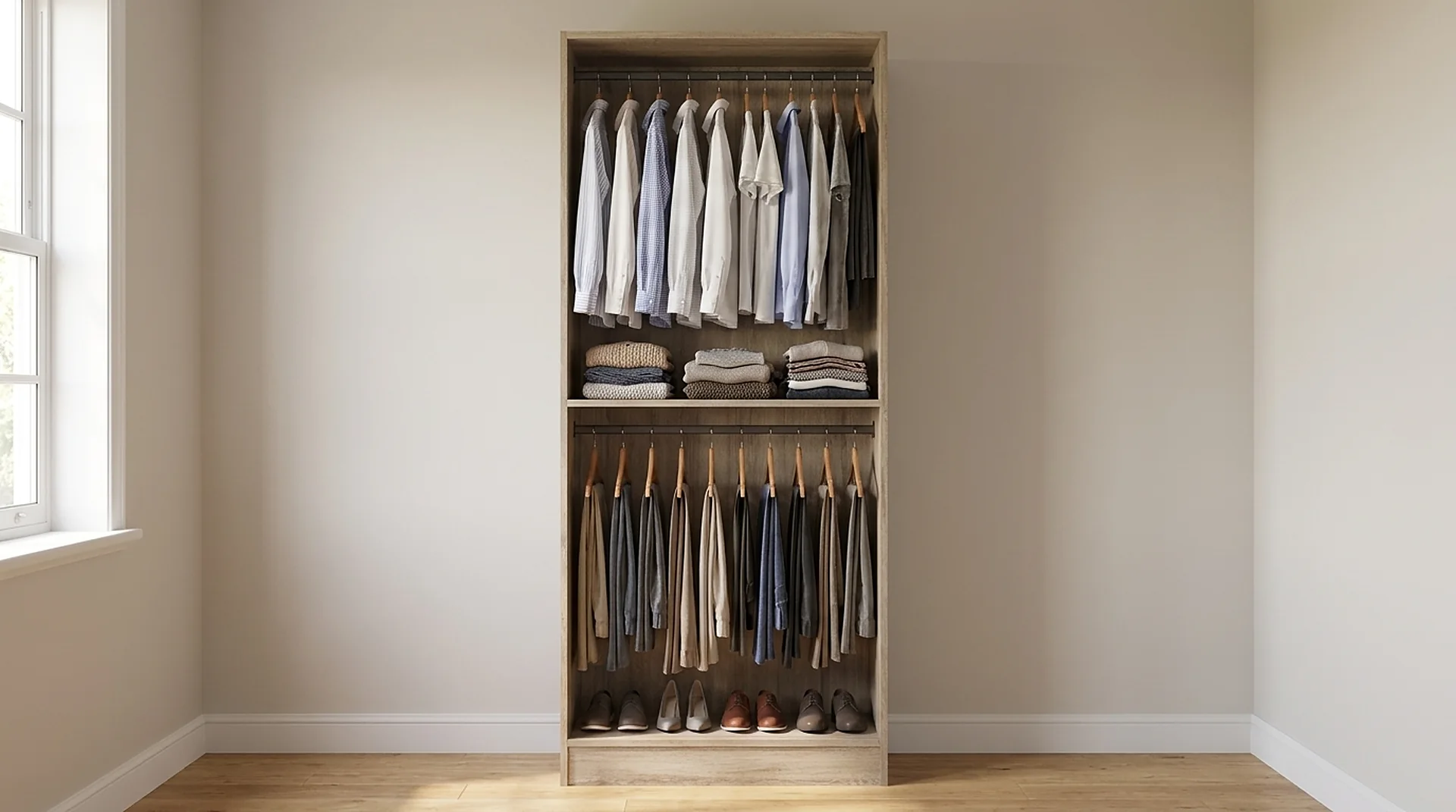
Count each category, multiply, and add the results. A wardrobe of 40 shirts, 12 jackets, 20 trousers and 6 coats needs roughly 40 + 27 + 30 + 18 = 115 inches, or about 10 feet of rod — plus the 20 percent breathing room, so call it 12.
Count what you keep, not what you own
The count is only useful if it is the wardrobe you will still own when the closet is installed. Three decluttering methods come up often enough to be worth naming, and all three work the same way: they force a decision on one item at a time instead of a verdict on the whole wardrobe. The 12-12-12 challenge asks for twelve things to donate, twelve to discard and twelve to put back where they belong. The 5-5-5 version is the same exercise at a smaller scale. The 3-3-3 method is not a purge at all — three tops, three bottoms and three pairs of shoes worn for a month, which shows what you reach for rather than what you keep. The wording of each varies with who is describing it; what does not vary is that they are counting exercises, and rod length is a counting problem.
Do that work before the count, not after. A rod measured against a wardrobe you are about to halve is wrong in one direction, and one measured the week the boxes arrive is wrong in the other. The 20 percent allowance covers drift over the years, not a decision you have already made.
Double hanging is where the capacity is
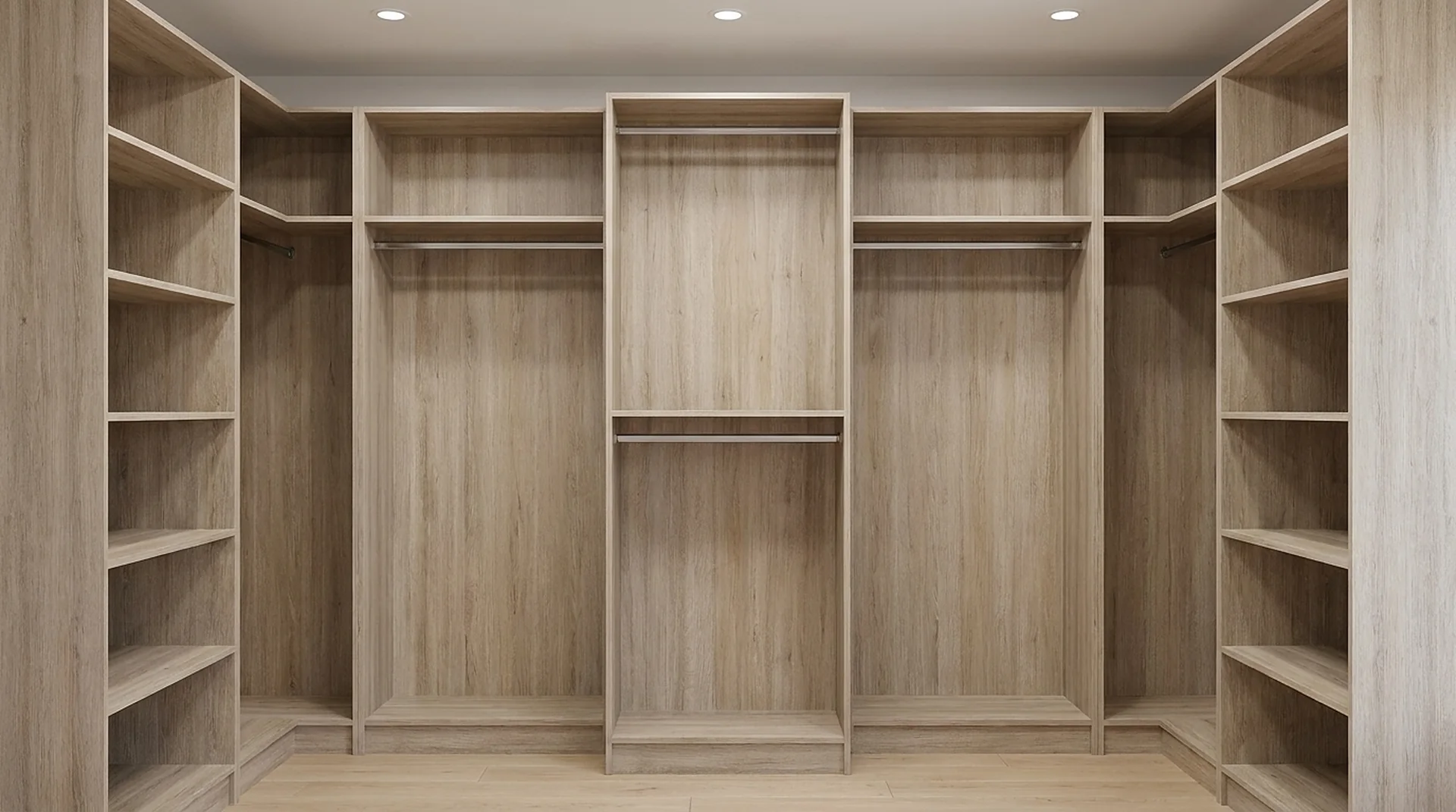
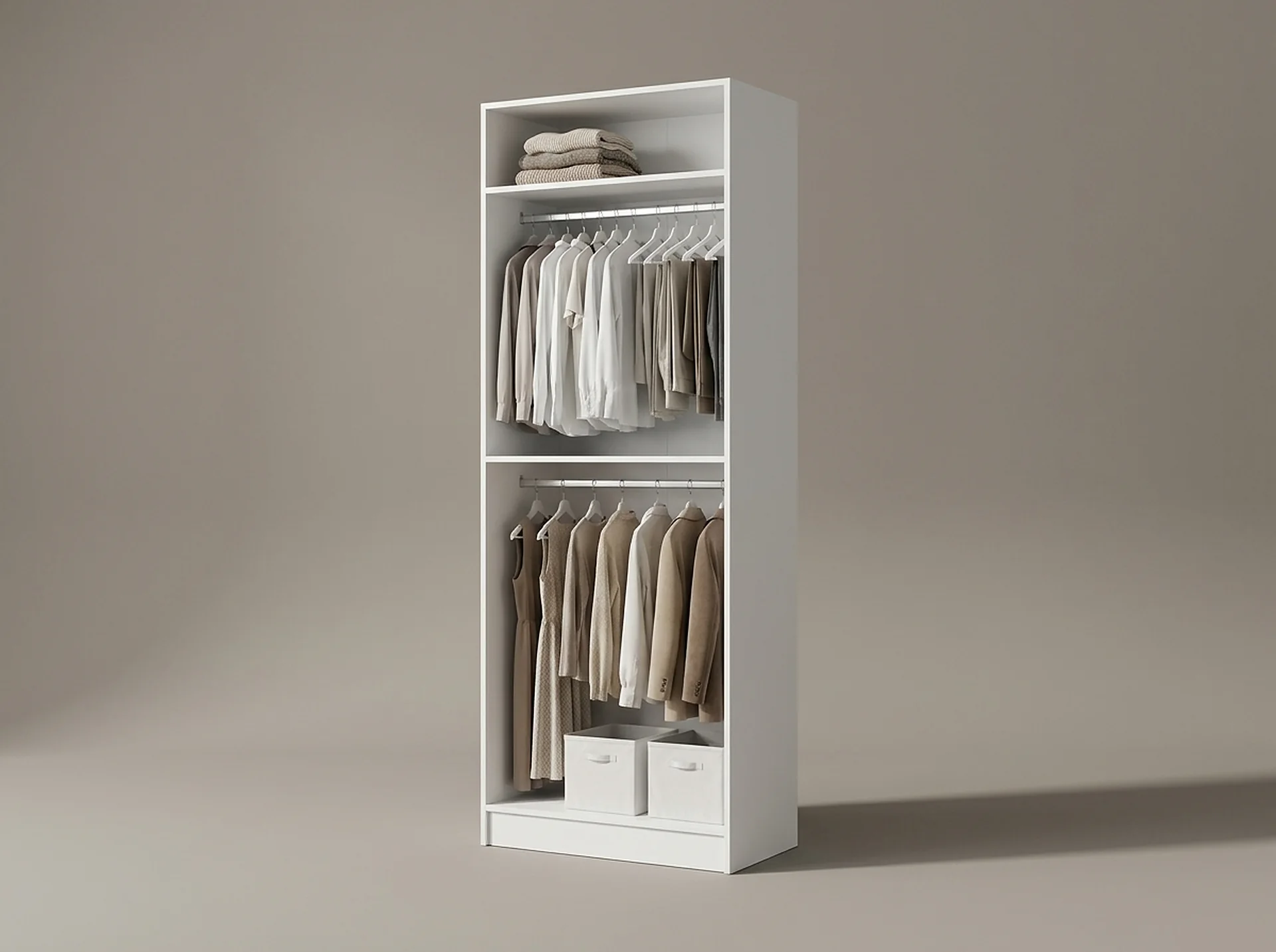
A 36-inch bay with a single rod gives you 36 inches of hanging. The same bay with two rods gives 72. That is the cheapest capacity in closet design and it costs one extra rail. The constraint is height: you need about 84 inches of clear cabinet to stack two 40-inch sections with clearance, which is exactly why the towers are 84 inches.
The mistake to avoid
Do not set rod heights from a catalog. Set them from your longest garment in each category, measured on the hanger you actually use. Velvet slimline hangers and chunky wooden ones differ by nearly an inch of drop, and a coat that brushes the shelf below is a coat you stop hanging there.
Hanger choice changes the arithmetic
The per-garment figures above assume slim velvet hangers. Chunky wooden hangers take roughly twice the rod width per garment, so a wardrobe that needs 10 feet on velvet needs closer to 16 on wood. This is the cheapest capacity change available: switching hanger type can free up a third of a rail without removing a single garment.
- Velvet slimline: about 0.5 in per garment. Grippy, so wide necklines stay put.
- Standard plastic: about 1 in.
- Wooden: 1.5 to 2 in. Correct for structured jackets, wasteful for shirts.
Leave the top rod reachable
In a double-hang bay the upper rod usually sits around 82 inches. That is reachable standing for most adults but not comfortably so for everyone. If the daily wardrobe lives up there and the seasonal one lives below, the closet works against you every morning. Put what you wear on the lower rod and what you wear rarely on the upper — the heights are set at the measure, so say this then.
Plan for growth, but not infinitely
Twenty percent of headroom is the right allowance. Much more and you are paying for cabinet that stands empty; much less and the closet is full the week it is installed. Shelves stay adjustable and rods can move, so a closet that is right today can be re-planned in an afternoon rather than rebuilt.
Quick answers
About this topic.
How much hanging space does the average person need?
Most single wardrobes land between 8 and 14 feet of rod. Count your garments and convert rather than guessing.
What height should a double hanging rod be?
Roughly 40 inches for the lower rod and 82 for the upper, inside an 84-inch tower. Final heights get set from your longest garment.
Can I mix double and single hanging in one closet?
Yes, and most closets should. Double hanging for shirts and folded trousers, one full-height bay for coats and dresses.
What height should a single closet rod be?
About 66 inches for a long-hang bay sized for coats and dresses, inside an 84-inch tower. The final height gets set at the field measure, from your longest garment rather than from a chart.
How high should the shelf above a closet rod be?
Directly above the rod: with long hang at about 66 inches, the shelf above it lands near the top of the 84-inch tower. Every shelf and rod position moves on the same 32 mm pin grid, so the pairing can be re-spaced later without tools.
What is the 3-3-3 rule for decluttering?
Wear three tops, three bottoms and three pairs of shoes for a month and nothing else. It is a wardrobe experiment rather than a purge: at the end you know which garments you actually reach for, and that is the number a closet layout needs. None of these methods has an owner, so the counts and even the categories vary with who is describing them.
What is the 5 5 5 rule for decluttering?
Find five things to donate, five to throw away and five to put back where they belong. It is the 12-12-12 challenge at a scale that fits one session, which is the whole point of it. Like the others it is a folk method rather than a standard, so descriptions of it vary.
What is the 12-12-12 rule for decluttering?
Twelve items to donate, twelve to discard and twelve to return to their proper place, in a single pass. What makes it work is not the number but that each item is judged on its own rather than as part of a wardrobe you are trying to feel decisive about. It is a folk method rather than a standard, and the counts vary with the telling.
What is the hardest thing to declutter?
Clothes kept for a size you are not wearing now, and pieces kept for what they meant rather than for wear. Both are decisions about the future rather than about a garment, which is why they stall a session. The practical answer is not to decide: give them one labeled section, and let the rod length it takes make the argument.
Start here
Tell us the room. We will tell you what fits.
A field measure, a dimensioned drawing and a fixed price — in that order, before anything is cut.