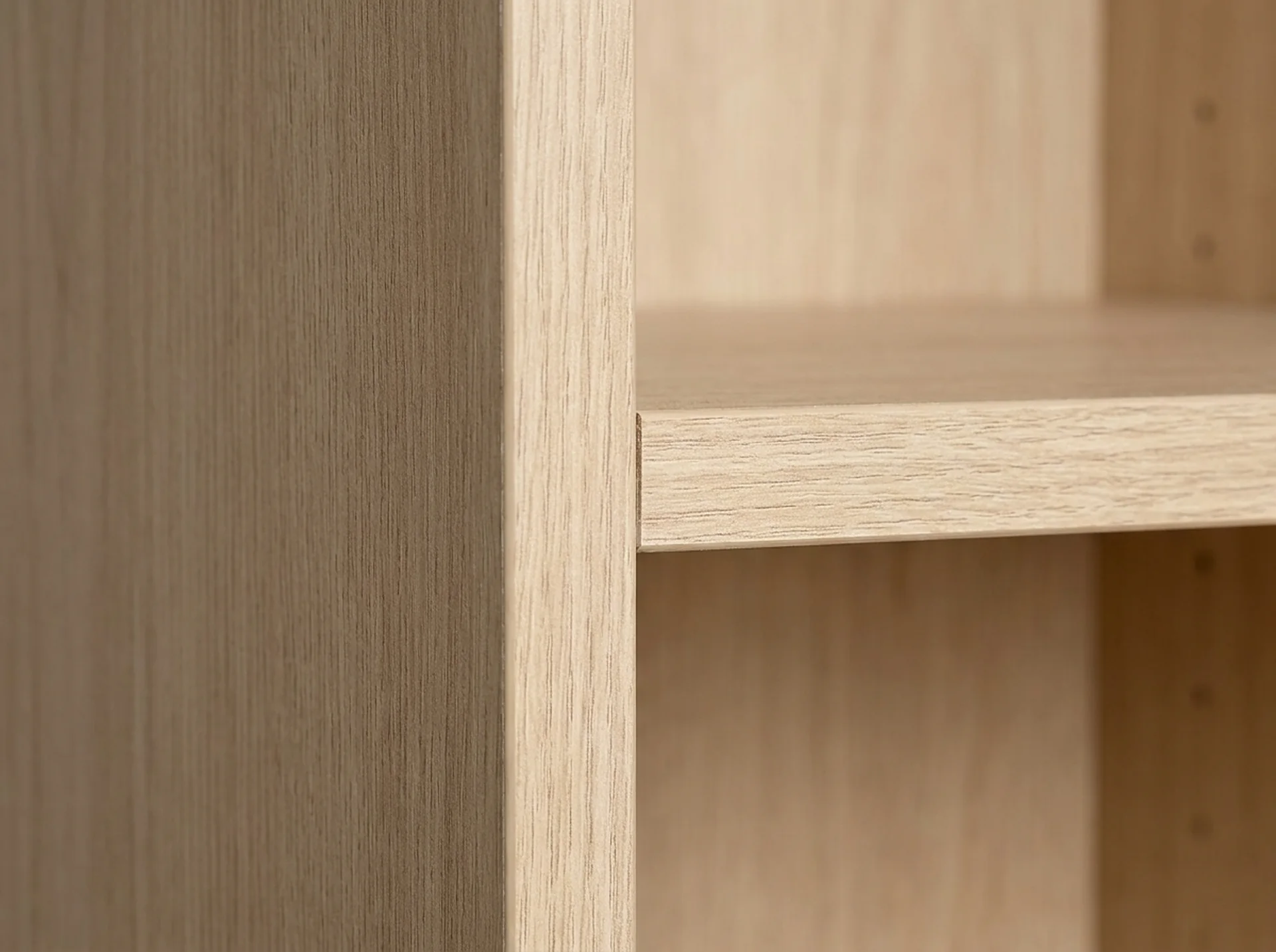
Materials
Melamine vs Wood vs Wire: What Closet Systems Are Made Of
What each material does under load, how each one fails, and why cabinet-grade melamine became the default for built-in closets.
Cabinet-grade melamine is the default for built-in closets because a 3/4-inch panel stays flat under folded clothes, takes an edge-banded front face, and does not move with Georgia humidity the way solid wood does.
Closet material arguments usually get framed as cheap versus premium. That is the wrong axis. The right question is what the shelf does when you stack fourteen sweaters on it in August.
Wire shelving
Wire is the cheapest system and the one most often replaced. It carries load through widely spaced steel rods, so anything soft — knitwear, folded shirts, handbags — takes a ridge pattern. It cannot be closed with a door that reads as cabinetry, and it offers no drawer path at all.
Solid wood
Solid wood is beautiful and it is the most reactive material in the list. Wide solid panels cup and move seasonally, which matters in a closet where a 24-inch shelf sits against a wall and a door has to keep closing flush through a humid summer. It is also the most expensive by a wide margin.
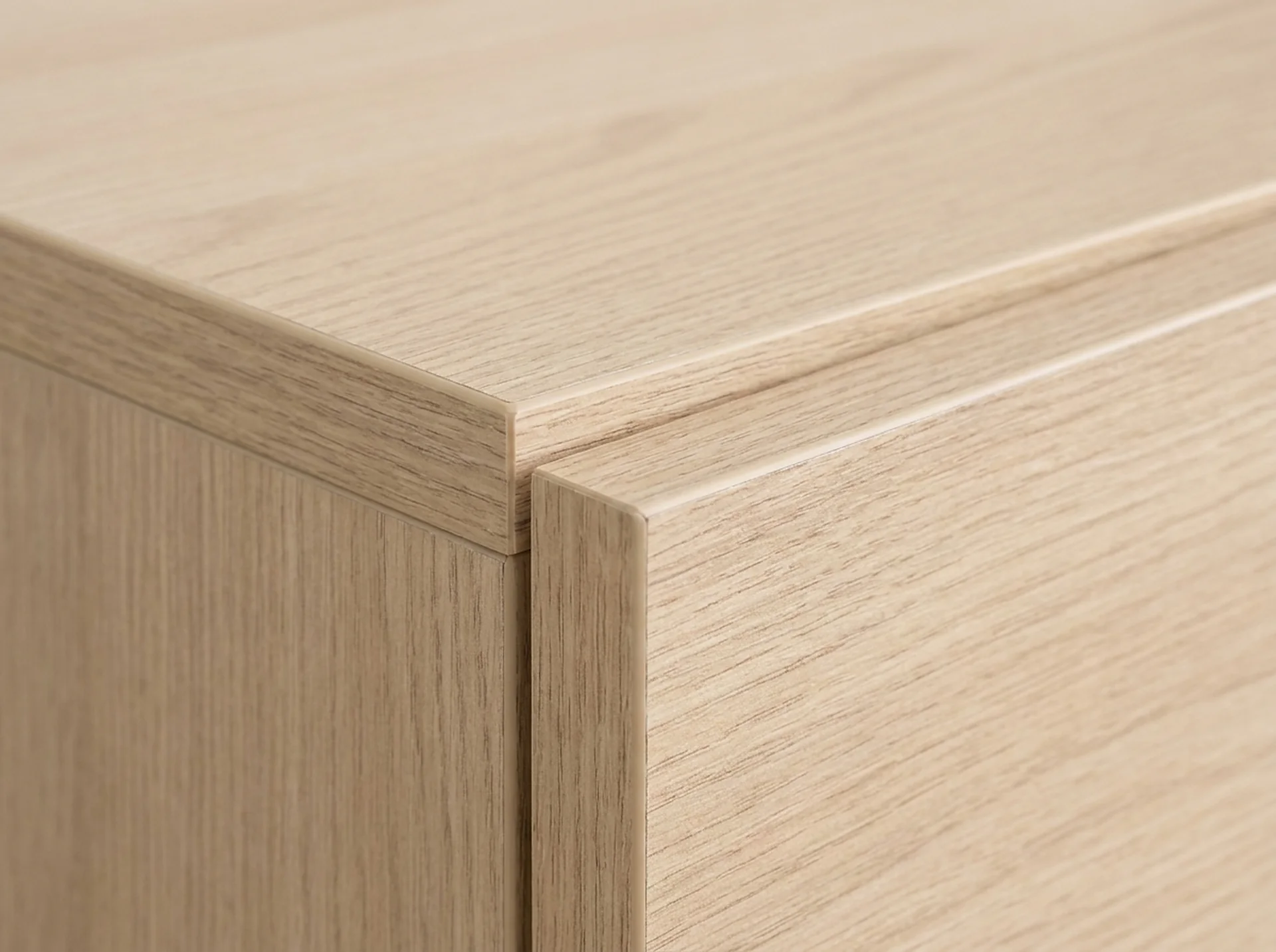
Cabinet-grade melamine
Melamine is a dense engineered core with a fused decorative surface. The surface is the point: it is harder than a painted finish, it does not absorb humidity, and it wipes clean. The core is dimensionally stable, so a shelf that is flat on install day is flat in four years.
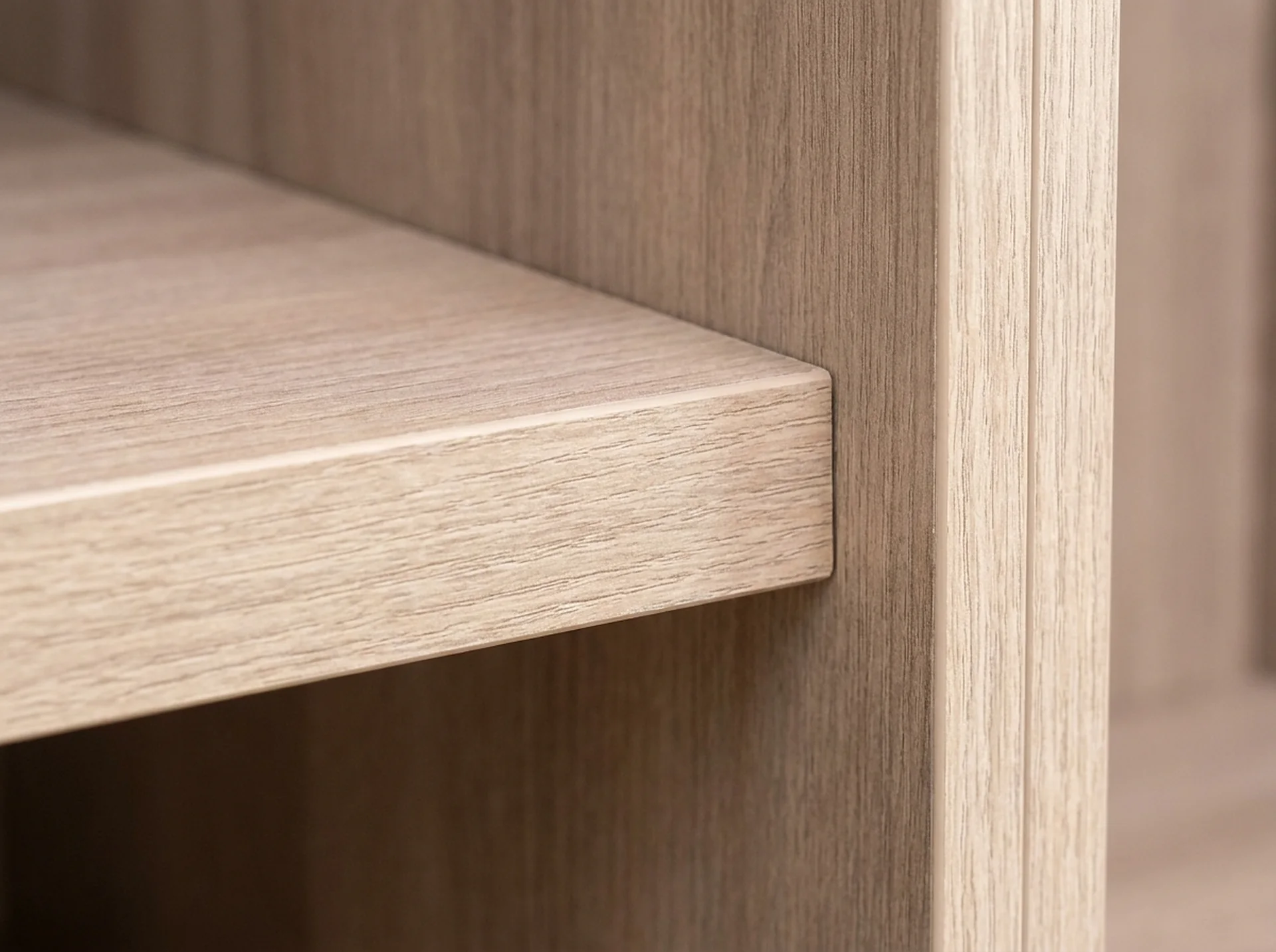
- 3/4 inch, not 1/2. Thickness is what resists deflection. Half-inch shelving at a 30-inch span will bow under folded clothes.
- Edge banding on the front face. The exposed core edge is where moisture and impact damage start. Banding it is not cosmetic.
- Span discipline. Even good panel has a limit; that is why towers come in fixed widths rather than any width you like.
The three materials side by side
| Material | What a loaded shelf does | How it fails | Doors and drawers | Relative cost |
|---|---|---|---|---|
| Wire | Carries load on widely spaced steel rods | Ridge pattern in knitwear, folded shirts and handbags | No door that reads as cabinetry, and no drawer path | Cheapest, and the most often replaced |
| Solid wood | Wide panels cup and move seasonally | A flush door stops closing through a humid summer | Full cabinetry | Most expensive by a wide margin |
| Cabinet-grade melamine, 3/4 in | Flat on install day is flat in four years, to about a 36-inch span | At the front edge, where an unbanded core meets moisture and impact | Full cabinetry, edge-banded front face, six finishes | Between the two |
| Melamine, 1/2 in | Bows at a 30-inch span under folded clothes | Deflection, long before the surface gives out | The same doors, but the shelf is the weak point | Lower, and the most common cause of a bowed closet shelf |
The honest trade-off
Melamine will not give you the figure of a walnut board, and we will not pretend otherwise. What it gives you is a closet that holds its line, in six finishes including two wood grains, at a price that lets you spend the difference on drawers rather than shelving — which is where daily quality of life in a closet actually lives.
How to tell cabinet-grade panel from shelf board
- Weight. Cabinet-grade panel is noticeably denser. A 24-inch shelf that feels light is light because there is less material resisting deflection.
- Edge treatment. Look at the front face. A banded edge is a continuous, matched strip; a painted or taped edge shows the core texture through it.
- Core color. A uniform, fine core is a better sign than a coarse chip pattern with visible voids.
- Thickness. 3/4 inch for shelving. Half-inch shelving spans badly and is the single most common cause of a bowed closet shelf.
Span is the number that decides sag
Deflection rises steeply with unsupported span — doubling the span does far more than double the sag. This is why the towers come in fixed widths rather than any width you like: 36 inches is about the practical limit for a loaded 3/4-inch shelf, and beyond that the shelf needs support rather than optimism.
What about painted MDF?
Painted MDF looks excellent on day one and is common in furniture-style closets. Its weakness is exactly where closets get abused: the bottom edge at the toe kick, where a mop or a wet shoe meets it. MDF swells when it takes water and the paint film chalks at the swelling. In a laundry room or a mudroom this is not theoretical.
Quick answers
About this topic.
Is it better to have wire or wood closet shelves?
For most closets, neither wire nor solid wood is the best shelf material. Wire is the cheapest but leaves ridges in folded knits and cannot take a drawer; solid wood looks best but cups and moves with seasonal humidity and costs the most. Cabinet-grade melamine with edge-banded fronts stays flat and wipes clean.
Is melamine the same as particleboard?
No. Particleboard is a core material; melamine refers to the fused surface on top of a dense engineered core. Cabinet-grade panel is denser and flatter than shelf board sold by the foot.
Will melamine chip?
The face is hard and wipes clean. Chipping risk lives at unbanded edges, which is why every exposed front face in the program is edge-banded.
Can melamine handle Georgia humidity?
Yes. The fused surface does not absorb moisture and the core is dimensionally stable, which is why it outperforms solid wood in closets here.
What are the disadvantages of using wire shelving?
Three, and they compound. Wire carries load on widely spaced steel rods, so anything soft — knitwear, folded shirts, handbags — takes a ridge pattern. It cannot be closed with a door that reads as cabinetry. And it offers no drawer path at all, so folded and small-item storage has to go somewhere else. It is the cheapest system and the one most often replaced.
Which is better for closets, MDF or melamine?
For a closet, cabinet-grade melamine. Painted MDF looks excellent on day one and is common in furniture-style closets, but its weakness sits exactly where closets get abused: the bottom edge at the toe kick, where a mop or a wet shoe meets it. MDF swells when it takes water and the paint film chalks at the swelling — in a laundry room or a mudroom that is not theoretical. The melamine face does not absorb moisture and the core is dimensionally stable.
Start here
Tell us the room. We will tell you what fits.
A field measure, a dimensioned drawing and a fixed price — in that order, before anything is cut.